On 25
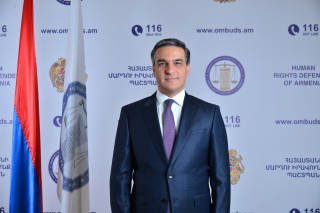
February, the Human Rights Defender of the Republic of Armenia, Ms. Anahit
Manasyan, received Ms. Nare Hovhannisyan, the founder-president of the “Legal
Initiatives Center” NGO.
The
Defender welcomed the guest and expressed appreciation for the effective
cooperation, emphasizing the importance of professional and consistent
addressing of the issues existing in the field.
During
the meeting, a number of issues related to cooperation in the field of the
protection of the rights of persons deprived of liberty were discussed. In
particular, reference was made to existing challenges within the penitentiary
system, the importance of gender-sensitive training of professionals in the
field, as well as the need to raise public awareness.
Within
the framework of the meeting, Ms. Nare Hovhannisyan presented the program
implemented by the “Legal Initiatives Center” NGO under her leadership,
referring its objectives, target direction and expected results. Opportunities
for further cooperation and prospects for joint initiatives were also
discussed.
Ms.
Anahit Manasyan highlighted the importance of ensuring the continuity of
training for employees in the field, emphasizing that the development of
professional capacities and the provision of up-to-date knowledge are key
preconditions for the effective protection of human rights.
The
Defender also underscored the importance of solidarity and joint efforts among
human rights defenders, emphasizing that they play a crucial role in
implementing sectoral reforms and overcoming systemic problems.
“Each
of us has clearly defined functions in this field. We cannot achieve our
objectives alone. Cooperation programs are essential, the challenges are
numerous, and comprehensive and consistent steps are required in this direction.
The proper engagement of civil society is of key importance,” emphasized the
Defender.
Ms.
Anahit Manasyan reaffirmed that overcoming the existing challenges in the field
of human rights protection is possible only through constructive and coordinated
cooperation between state bodies, civil society and other relevant
stakeholders.

 Հայերեն