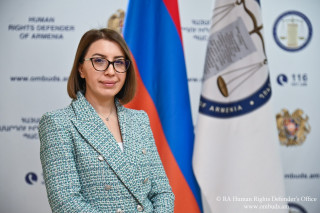
The
Human Rights Defender has repeatedly emphasized that Armenian public discourse
stands out for its discriminatory, intolerant, labeling, hate-inciting expressions
and targeting various social groups. On the eve of elections, such forms of
speech become even more widespread and become an integral part of the political
debate. The Human Rights Defender emphasizes that this circumstance is
unacceptable and must be adequately countered.
In
Armenia’s public discourse, there has been a growing prevalence of stigmatizing
and targeting language against women and persons with disabilities,
discriminatory and hate speech based on ethnic affiliation, as well as
discriminatory rhetoric directed at representatives of the Armenian Apostolic
Holy Church, other religious organizations, and atheists.
In
recent days, stigmatizing language targeting women and containing gender-based
prejudices has become the subject of broad public discussion. Such wording, in
effect, undermines women’s dignity. Gender-based stereotypes and misconceptions
about the role of women are, unfortunately, deeply rooted in society and
persist at all levels of public life, contradicting the principle of equality.
The
Human Rights Defender condemns any such manifestation of speech and any
justification of unacceptable behavior arising from it. Moreover, it is even
more worrying that within the context of public perception, such expressions of
speech are often not regarded as problematic and do not receive the necessary
response.
Equally
unacceptable is the targeting and labeling of persons with disabilities,
including those with mental health conditions, as well as the discriminatory
speech directed at them, in the context of political debate. The Human Rights
Defender also considers inadmissible the widespread use by certain political
actors and public figures of hate speech, stigmatizing, and discriminatory
expressions based on ethnic or national origin (for example, using terms such
as “Turk,” “Yazidi,” and similar expressions as insults).
Problematic
situations related to the observance of guarantees of freedom of religion
continue to be recorded, including cases of targeting representatives of the
Armenian Apostolic Holy Church, other religious organizations, and atheists, as
well as manifestations of discriminatory and hate speech against them. The
Human Rights Defender considers such manifestations of public speech
inadmissible and emphasizes that any issue may be the subject of democratic
debate, but this must not be carried out through violations of human rights
standards and guarantees related to freedom of religion.
The
Human Rights Defender made a public statement months ago on the importance of the
unwavering observance of guarantees related to freedom of religion, including
respect for the autonomy of religious organizations. The Defender reaffirms the positions
set out in that statement and emphasizes that, in all cases where processes
carried out by law enforcement bodies concern representatives of the Armenian
Apostolic Holy Church or other religious organizations, law enforcement and
other competent authorities are obliged to demonstrate the necessary sensitivity,
respect individuals’ religious beliefs, and conduct such processes—and related
public communication—in a manner that does not give rise to even the slightest
public impression that religious beliefs are being disrespected or that
criminal proceedings are carried out on the basis of religious beliefs.
At
this stage, several criminal legal processes against representatives of the
Armenian Apostolic Holy Church are resonant. In one of the cases, public debate
has arisen as to whether the issue could have been addressed within the
framework of legal proceedings, taking into account the autonomy of the Church.
While acknowledging the existence of a judicial act in the case and without
interfering in the activities of the courts in any way, the Human Rights
Defender considers the public communication conducted by the competent
authorities on this matter to be insufficient. She emphasizes that with regard
to such sensitive and legally controversial issues, it is necessary to conduct
continuous, comprehensive communication in accordance with international
standards, presenting the grounds for the legality of the actions of the
competent authorities. Moreover, public communication on the mentioned issues
should be carried out while maintaining the necessary sensitivity.
The
Human Rights Defender also keeps under direct attention issues related to
guaranteeing the freedom of religion of persons deprived of liberty. A number
of issues related to ensuring this right in places of deprivation of liberty
have been resolved in the course of cooperation between the Human Rights
Defender’s Office and competent authorities. At the same time, the Defender
deems it necessary to reiterate that guaranteeing freedom of religion for
persons deprived of liberty involves numerous peculiarities and therefore
requires a systemic approach and the development of conceptual solutions.
The
Human Rights Defender emphasizes that representatives of public authorities,
political and public figures, mass media and professional communities should
play an active role in both preventing prohibited types of speech and
countering such speech, guided by the promotion of respect for diversity, the
elimination of discrimination and the formation of public solidarity and a
healthy public discourse.
In
this regard, the Defender considers it concerning that discriminatory,
hate-inciting, labeling, and targeting speech is used by nearly all actors,
while responses to such speech are often carried out through other labeling and
discriminatory expressions, which cannot be justified and must similarly be met
with appropriate counteraction.
Considering
the above, the Human Rights Defender calls on all actors to exclude
discriminatory and hate speech against any person or group of persons on any
grounds when engaging in political or any other public discussions, and to
conduct public discourse and all legal processes in strict observance of human
rights standards.

 Հայերեն